Fun facts about Christmas are a great way to learn where our holiday customs actually come from. This guide collects 46 well-documented facts about Christmas, from American traditions to some of the more bizarre facts about Christmas around the world.
Fun Facts About Christmas in the United States
- Alabama was the first state to make Christmas a legal holiday, in 1836. Christmas became a federal holiday on June 26, 1870, when President Ulysses S. Grant signed the law.
- Not every early American colony liked Christmas. The Massachusetts Bay Colony banned its celebration in 1659, and the law was repealed in 1681.
- The National Christmas Tree was first lit at the White House in 1923 under President Calvin Coolidge.
- The first Rockefeller Center tree was put up by construction workers in 1931. The official tree-lighting ceremony began in 1933.
- The first electrically lit Christmas tree is credited to Edward Johnson, an associate of Thomas Edison, who displayed one in New York City in 1882.
- Louis Prang, a Boston printer, helped popularize Christmas cards in America in the 1870s and 1880s, and is often called the father of the American Christmas card.
- The U.S. Postal Service has answered children’s letters to Santa through its Operation Santa program, which traces back to 1912.
- NORAD’s Santa tracking began in 1955, when a department store ad in Colorado Springs printed the wrong phone number and children called a military hotline instead. The staff on duty played along.
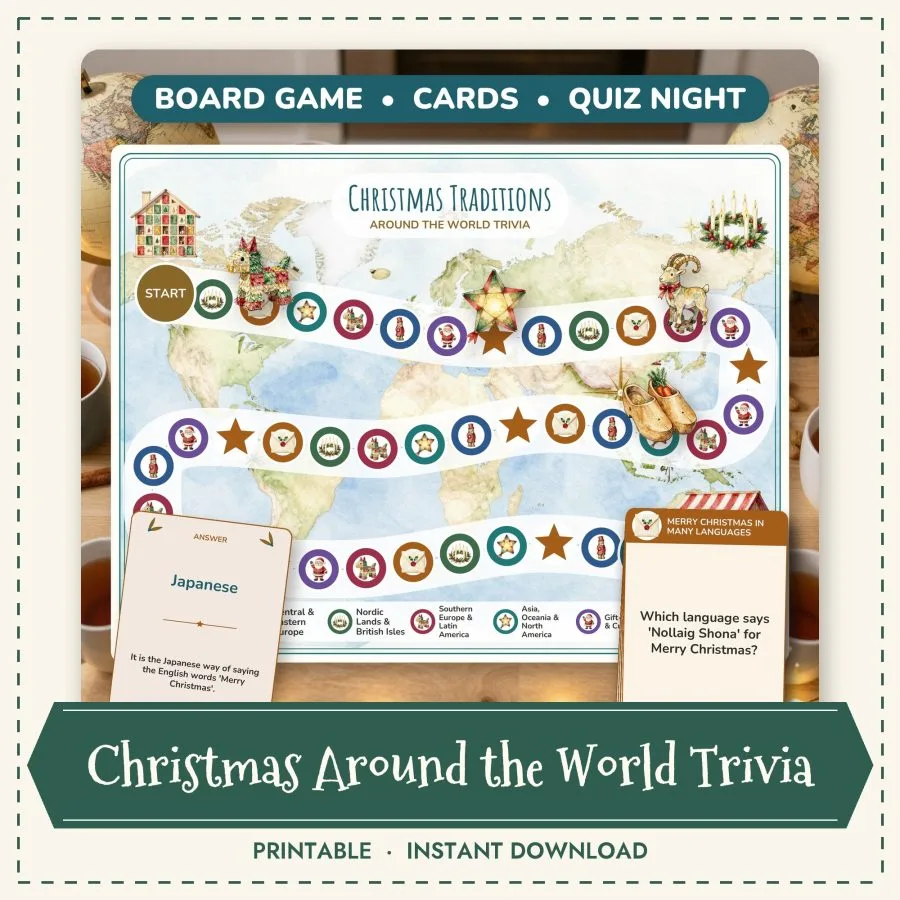
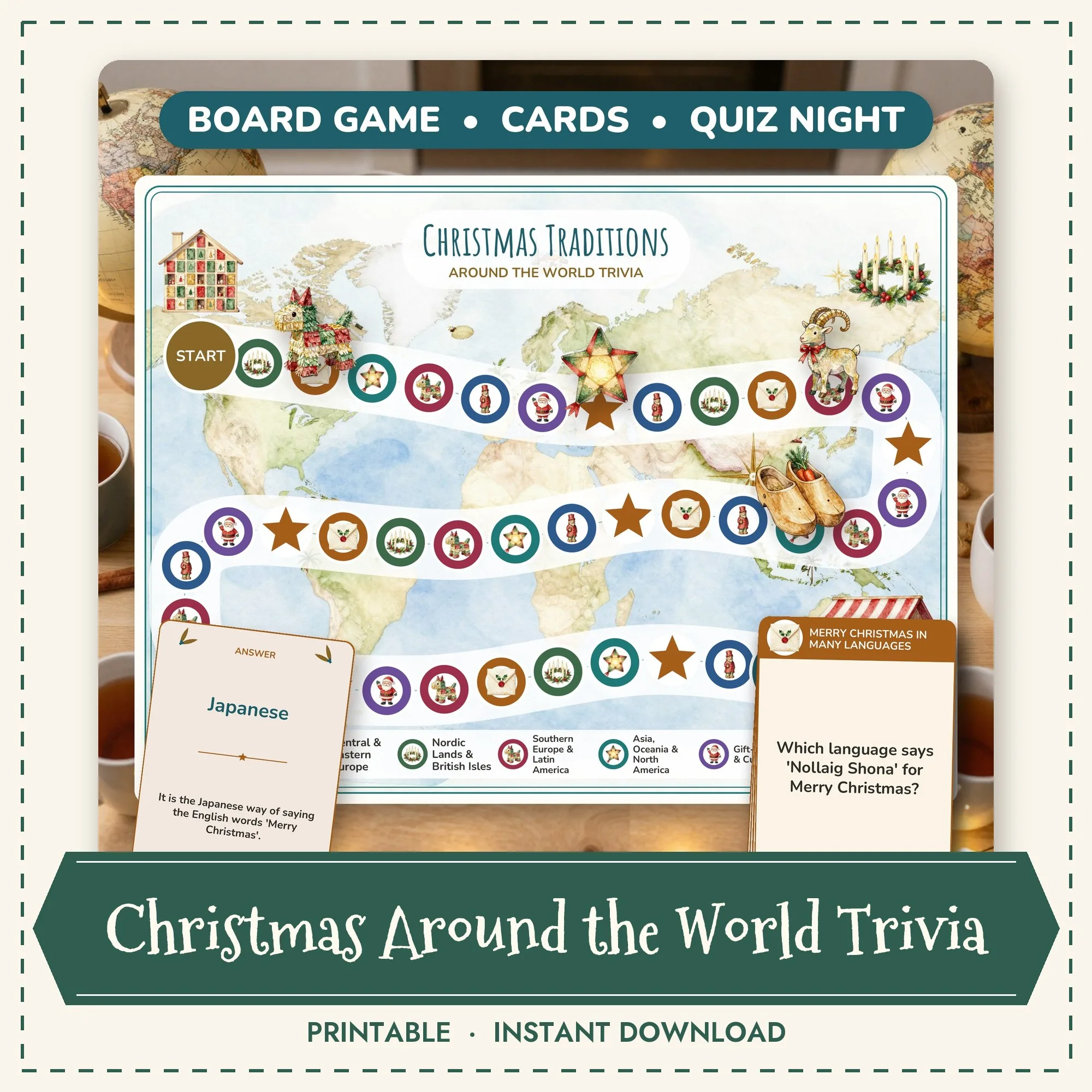
Want it ready to print? Our Christmas Around the World Trivia pack turns customs like these into 150 printable questions.
Santa Claus and Rudolph
- Santa Claus grew out of Saint Nicholas, a fourth-century bishop of Myra in what is now Turkey. The name “Santa Claus” comes from the Dutch Sinterklaas.
- The poem “A Visit from St. Nicholas,” published in 1823, gave Americans eight named reindeer, a sleigh and the chimney. It is now credited to Clement Clarke Moore, though some scholars dispute that.
- Cartoonist Thomas Nast drew Santa for Harper’s Weekly in the 1860s and 1870s, helping fix his round shape, white beard and North Pole workshop in the public mind.
- Santa wore red long before Coca-Cola’s ads. The company’s artwork, begun in 1931, helped make that image familiar everywhere, but it did not invent it.
- Rudolph was created in 1939 by Robert L. May for a Montgomery Ward booklet. The song followed in 1949, performed by Gene Autry.
- Reindeer and caribou are the same species. Male reindeer shed their antlers in late fall or early winter, while females keep theirs through winter. So any reindeer pulling a sleigh on Christmas Eve would most likely be female.
Bizarre Facts About Christmas Around the World
- In Iceland, 13 Yule Lads visit in the days before Christmas, and folklore tells of a Yule Cat that threatens people who do not receive new clothes.
- Icelanders also give books on Christmas Eve and spend the evening reading. The custom is known as the Jolabokaflod, or “Christmas book flood.”
- In Alpine countries, St. Nicholas has a fearsome companion called Krampus, a horned figure of folklore who is said to scare misbehaving children.
- In Catalonia, Spain, children beat a log called Caga Tio with sticks so that it will “deliver” small gifts. Nativity scenes there also often include a figure called the caganer.
- In Japan, many families eat KFC on Christmas. The habit grew from a marketing campaign in the 1970s and is now a long-running tradition.
- In Caracas, Venezuela, a Christmas custom has people roller-skate to early morning Mass, and some streets are closed to cars for it.
- Some families in Ukraine decorate trees with artificial spider webs, based on a folk tale about a poor family whose tree was covered in webs that turned to silver and gold.
- In Norway, tradition holds that witches and spirits come out on Christmas Eve, so some families hide their brooms.
- Every December, the town of Gavle in Sweden builds a giant straw Yule goat. The tradition began in 1966, and the goat has been burned down on several occasions.
- In Italy, a kindly witch named La Befana brings gifts on the night before Epiphany, January 6.
Christmas History
- The Bible does not give a date for Jesus’s birth. The earliest record of Christmas on December 25 is from fourth-century Rome.
- Charlemagne was crowned emperor on Christmas Day in the year 800, and William the Conqueror was crowned king of England on Christmas Day in 1066.
- George Washington’s army crossed the Delaware River on Christmas night in 1776, leading to a victory at Trenton the next morning.
- On Christmas Eve 1914, soldiers along parts of the Western Front called an unofficial truce. Some exchanged small gifts and sang carols.
- The first commercial Christmas card was made in London in 1843 by Henry Cole, the same year Charles Dickens published A Christmas Carol.
- Christmas trees spread from Germany. They became popular in Britain after an 1848 magazine illustration showed Queen Victoria and Prince Albert with their tree, and in America through the 1800s.
- The “X” in “Xmas” is not a modern invention to remove Christ. It stands for the Greek letter chi, the first letter of Christos.
- The word “Yule” comes from an older Germanic midwinter festival, and it became another word for Christmas in English.
- In 1826, a drunken Christmas party at West Point turned into the “Eggnog Riot.” It involved around 70 cadets and led to several being dismissed.
Quiet moment between gifts? The Christmas Word Search Book has 100 printable puzzles you can print again and again.
Christmas Music, Movies and Space
- “Jingle Bells” was first published in 1857 as “One Horse Open Sleigh” and written by James Lord Pierpont.
- “Silent Night” was first performed in Austria on Christmas Eve 1818. The original German title is “Stille Nacht.”
- Bing Crosby’s “White Christmas,” written by Irving Berlin, is widely cited as the best-selling single of all time.
- In 1965, astronauts on Gemini 6 played “Jingle Bells” with a harmonica and small bells, in what is often called the first music played in space.
- On Christmas Eve 1968, the crew of Apollo 8 read from the Book of Genesis during a broadcast from lunar orbit.
- “The Twelve Days of Christmas” adds up to 364 gifts if you count every repeat, one for every day of the year except one.
Plants, Food and Decorations
- The poinsettia is native to Mexico and is named after Joel Roberts Poinsett, the first U.S. ambassador to Mexico. National Poinsettia Day on December 12 marks the date of his death in 1851.
- Poinsettias have a reputation for being deadly, but the ASPCA lists them as only mildly irritating if a pet eats some.
- Mistletoe, on the other hand, is toxic if eaten, which is a good reason to keep real sprigs out of reach of children and pets.
- Real Christmas trees take years to reach retail size, commonly about seven to ten years.
- The Christmas pickle is often called a German tradition, but its origin is unclear and many Germans have never heard of it.
- The story that the candy cane was invented to teach Christian symbols is a legend. There is no solid evidence for it.
- Christmas crackers, a British tradition, were invented by confectioner Tom Smith in the 1840s.
Fun fact lists make good party warm-ups. If you would like to turn them into a game, try our Christmas trivia questions and answers or browse the full Christmas trivia collection.
Final Thoughts
Many Christmas facts are surprising because the traditions we take for granted are newer, odder or more varied than we expect. Share a few at dinner, tuck one into each place setting, or save them for a quiet Christmas Eve. Every family tradition has a story behind it, and these are only a few of them. Come back each December, because there is always another story worth sharing.